A Love Letter to the Sri Lankan Love Cake
Where were you when you first tasted a Sri Lankan Love Cake?
I returned from college, ravenous for a snack, slung my bag in the hallway and charged into the kitchen where my mother had baked a cake.
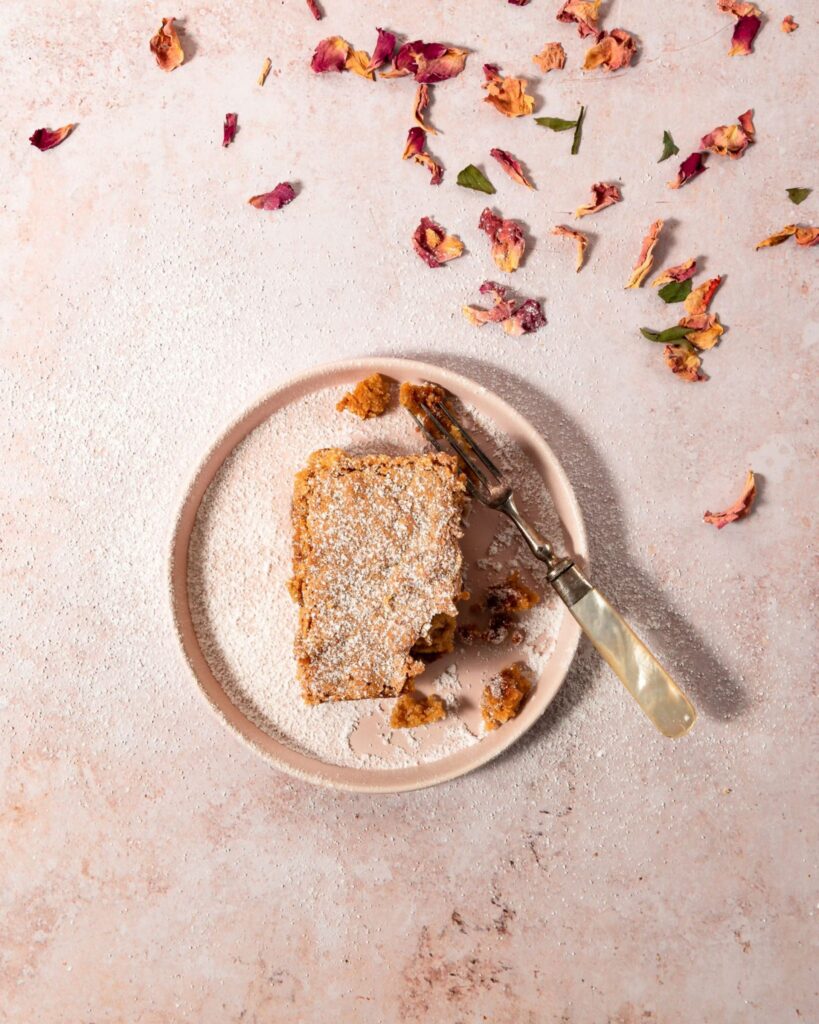
The first thing that hit me was the smell. I inhaled spices, citrus and rose. Then the texture: a crackly surface giving in to a moist crumb. This was nothing like the usual cakes I was used to eating – Victoria sponge, Batternberg and those Kipling slices. This was different. This was a Sri Lankan Love Cake.
Mum was a super baker. Birthday cakes were her forte and her speciality was to patiently make sugarcraft roses and pile them on top of a royally iced cake.
I remember having one such cake and taking it to my McDonald’s birthday party. McDonald had first arrived in Harrow and my little party troupe were given a kitchen tour. I was presented with a giant colouring book and a pack of felt-tip pens. And while the gherkins were sent flying around the restaurant, burgers and chips scoffed, my mother’s beautiful cake was demolished by my rambunctious band of friends.
Unlike that rose-topped cake, a Sri Lankan Love Cake is a plain to look at. You’d probably describe it as a traybake-kind-of-cake.
But don’t be fooled, Love Cake is far from your standard traybake.
Love cake is rich. The number of eggs can seem eye-watering. My recipe has seven eggs. Charmaine Solomon (one of the grande dames of Sri Lankan cooking) has two recipes, one with seven eggs and another with ten. The Ceylon Daily News (the bible of Sri Lankan cooking) has two recipes one with seven eggs and another with twelve. As I said, rich. It’s the eggs that bind the ingredients together.
Love Cake is dense and as you bite through the crisp, bubbly crust you’re rewarded with a soft, moist fudge-like cake drenched in flavour. The crisp surface is down to the whipped egg whites added at the end of the recipe to loosen the cake batter and act as a leavening agent.
Love Cake is sweet but not cloyingly so. The half a kilo of sugar and honey meld into the semolina and cashew nuts, which are enveloped by cardamom, cinnamon, cloves, and nutmeg and essences of orange, lemon and rosewater.
Originally called Bolo d’Amor, we think Love Cake dates back to the 16th century around the time the Portuguese arrived and ruled Sri Lanka. It combines traditional Portuguese cake ingredients such as semolina with native spices.
Love Cake is wrapped in myth and folklore with tales of Sri Lankan women baking this cake to win the hearts of Portuguese sailors; or that you make Love Cake to win the heart of your love. Some say making Love Cake is a labour of love, hence the name.
Perhaps it is far simpler than that, for a recipe that has lasted over 500 years, we Sri Lankans love Love Cake.
PRINT RECIPE